

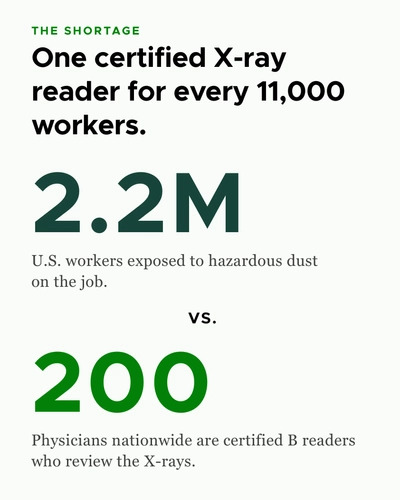
From coal miners and construction crews to engineered stone countertop fabricators and foundry workers, more than 2.2 million U.S. workers inhale fine particles of rock, sand or coal every day on the job. After years of exposure, trapped dust can cause thick scar tissue to build up inside the lungs leading to long-term lung damage commonly known as black lung or silicosis.
Early diagnosis helps organizations know how to care for their employees, so regular chest X-rays are required. Because the particles that get trapped in lungs are very small, the X-rays are reviewed by specially trained physicians known as B readers. In the U.S. right now, there are just 200 B readers, which is a massive shortage.
To offer workers faster protection, researchers from Michigan State University organized a specialized dataset of U.S. worker scans to train an artificial intelligence, or AI, program. Funded by a $600,000 grant from the National Institute for Occupational Safety and Health, or NIOSH, this is the first tool of its kind built specifically using images from U.S. workers. MSU’s study was published(opens in new window) in Occupational and Environmental Medicine.
“For workers in dusty environments, time is everything,” said Kenneth Rosenman(opens in new window), chief of the Division of Occupational and Environmental Medicine within the MSU College of Human Medicine(opens in new window) and a certified B reader. “If a worker’s lung disease goes undetected because of screening delays, they may remain in a high-dust environment, and their lungs will continue to scar. By giving doctors an objective second opinion, this tool helps us catch disease at the early stage, allowing employers to remove workers from dangerous dust and reduce the likelihood of the workers’ lung disease from progressing.”
Early screening benefits workers
Lung damage from dust develops slowly over 10 to 20 years and many workers do not realize their health is at risk until they begin experiencing severe breathing trouble. Crucially, once dust damages lung tissue, the scarring cannot be cured or reversed.
Early screening is the best way to ensure workplace dust controls are effective. This helps protect workers’ health before lung damage turns life-threatening. Spotting the disease in its earliest stages enables workers to transition to safer, dust-free roles before symptoms worsen and can prompt employers to install stronger ventilation systems to stop dust at the source. It also enables access to medical care to manage symptoms and prevent dangerous lung infections and secures eligible financial compensation for affected workers.
Every coal miner, for example, needs routine lung scans every five years, creating massive backlogs that delay necessary care. Compounding the issue, roughly 95% of routine workplace scans show healthy lungs, meaning specialists spend significant time reviewing clear images rather than focusing on sick patients. Early scarring from dust is difficult to see, leading to frequent disagreement and inconsistency among human readers.
“In medical imaging, the biggest challenges include a large volume of scans, challenging tasks, very few specialized doctors and decisions that carry a life-changing impact,” said Adam Alessio, professor in the departments of Computational Mathematics, Science and Engineering, jointly administered by the colleges of Engineering and Natural Science(opens in new window), Biomedical Engineering in the College of Engineering, and Radiology in the College of Human Medicine. “The early signs of dust-related lung disease are extremely subtle, far beyond what standard visual inspections pick up. Having a smart screening tool act as a copilot helps certified readers process these critical scans faster and more consistently.”
The AI solution
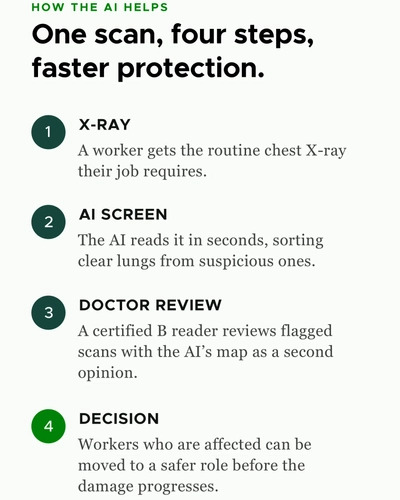
The MSU researchers demonstrated that their new program acts as an accurate, high-speed assistant across four distinct screening tasks. The program safely identified and cleared about half of all normal X-rays, removing healthy scans from the queue so human experts can immediately focus on workers showing early signs of illness. In addition, the software achieved 91% accuracy at spotting the earliest dots of lung scarring, outperforming human readers who averaged 77%. To assist clinicians, the program overlays a simple color map on the X-ray image so doctors can clearly see where early lung damage was detected. This provides fast reviews that serve as second opinions for the B readers so that workers can receive earlier results and documentation.
“As researchers with backgrounds in statistics and technology, we saw a clear opportunity to use AI tools to solve a massive health problem,” said Ling Wang(opens in new window), associate professor in the Division of Occupational and Environmental Medicine within the College of Human Medicine(opens in new window). “Because early signs of lung damage are so subtle, even experienced human doctors often disagree on what they see. Our goal was to train an AI tool that could act as a reliable second opinion, helping doctors catch tiny details they might miss and getting sick workers out of harm’s way before the disease progresses.”
The MSU research team includes doctoral students Meiqi Liu, Zenas Huang and Ian Loveless as well as undergraduate student Michal Borek. Together, the scientists are partnering with NIOSH to package the technology into an application for widespread use.
This story is sourced from MSU College of Engineering
Opportunities for Partnership
MSU’s AI screening tool tackles a real bottleneck in occupational health: with just 200 certified B readers in the U.S., millions of workers face long waits for results that could keep them out of harm’s way. As the team partners with NIOSH to package the technology into an application for widespread use, there are opportunities for organizations to help bring it into everyday practice. Medical imaging and health AI companies can explore licensing, integration into existing radiology platforms, or co-development of regulatory-ready products. Occupational health providers, mobile screening services and telehealth groups can partner on pilots that speed up surveillance programs. Employers in mining, construction, engineered stone fabrication and foundries, along with workers’ compensation insurers and industry associations, can collaborate on deployment studies that link earlier detection to safer workplaces and lower long-term costs. Organizations interested in sponsored research, data partnerships or field validation are invited to connect with MSU researchers.
Visit innovationcenter.msu.edu or contact us to start the conversation.
About the MSU Innovation Center
The MSU Innovation Center connects Michigan State University’s research in medicine, engineering and data science with industry and community partners who can carry it into the real world. By advancing tools like AI-assisted diagnostics from discovery to marketplace, the center helps solutions reach the workers and clinicians who need them. Through strategic corporate partnerships, technology transfer and licensing, startup support and translational funding, the Innovation Center accelerates the path from lab to impact, strengthening Michigan’s economy and improving health and safety for communities across the country.
Learn more: MSU Innovation Center