

As one of the world’s most widely used fertilizers, Ammonia plays a vital role in the global economy, helping support agricultural production on a massive scale. Increasingly, it is also attracting attention as a carbon-free energy carrier that could help store renewable energy, transport hydrogen, and support emerging clean energy systems. Yet despite its promising applications, ammonia’s properties have limited its potential as industry has struggled with the fact that ammonia is difficult, expensive, and potentially hazardous to store and transport.
Researchers at Michigan State University believe they may have found a solution.
Dr. Thomas Hamann, Professor of Chemistry at Michigan State University (MSU), and his research team have developed a novel approach that allows liquid ammonia to be stored at room temperature and ambient pressure. This technology has the potential to simplify ammonia handling, reduce infrastructure requirements, and open new opportunities across agriculture, energy storage, hydrogen production, and industrial markets.
Ammonia’s Promise—and Its Problem

For decades, anhydrous ammonia has been primarily associated with fertilizer production. Today, however, growing interest in renewable energy has expanded the conversation.
Many researchers, companies, and governments are exploring ammonia’s potential as a carbon-free fuel and energy storage medium. Ammonia can be produced using renewable electricity, stored for extended periods, transported long distances, and eventually converted back into energy when needed. As a result, it is emerging as a potential component of future low-carbon energy systems.
“Ammonia is one of the most attractive alternative fuels because it’s carbon-free, relatively easy to liquefy, and we already produce and distribute it at global scale,” Hamann said.
Yet ammonia’s practical use comes with important challenges. Under normal conditions, ammonia exists as a gas. To store it as a liquid, organizations typically rely on pressurized containers or refrigeration systems. These requirements increase complexity, raise costs, and introduce safety considerations for transportation, storage, and handling.
“There is strong interest in expanding the use of ammonia, whether for fertilizer or as an energy source,” Hamann said. “But one of the biggest barriers is storage. You still need a way to safely store and utilize ammonia.”
These barriers become even more significant as companies explore distributed production of “green ammonia” generated from renewable energy sources such as solar and wind power. Smaller-scale production systems could reduce transportation costs, improve supply chain resilience, and provide new opportunities for local fertilizer production. However, such systems also require practical and cost-effective storage solutions.

For companies working to scale clean ammonia production, storage and handling are not secondary considerations; they are central to whether the technology can be deployed safely and economically. Karen Baert, Co-Founder and CEO of Ammobia, a company developing modular feedstock-agnostic ammonia production systems, said safe, efficient, and cost-effective ammonia management remains a major operational challenge across bulk storage, terminal handling, and delivery to end users.
“Storage technologies play a critical role in determining safety performance, regulatory compliance, and overall system economics,” Baert said. “Systems that can reduce ammonia release risks while maintaining practical capacity could help address some of the key barriers producers face as they evaluate next-generation ammonia storage.”
That is the gap Hamann’s room-temperature ammonia storage technology is designed to address. By allowing liquid anhydrous ammonia to be stored under ambient conditions and released when needed, the approach could provide a practical storage pathway for distributed green ammonia production.
A Discovery That Changes the Equation
The discovery emerged from Hamann’s broader research program focused on energy storage, solar fuels, and ammonia electrochemistry.
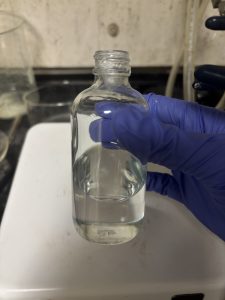
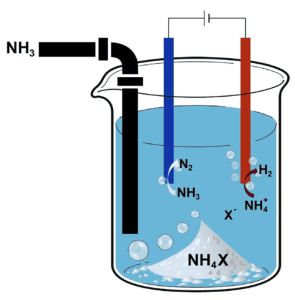 While investigating the chemistry of ammonia, Hamann’s research team made an unexpected discovery. Under the right conditions, ammonia combined with certain salts to form a stable liquid at room temperature and atmospheric pressure, a finding the team published in 2022. The researchers coined the term eurestic to describe this liquid ammonia formed by mixing a solid and a gas under standard conditions. Derived from the Greek phrase meaning “easy to liquefy,” the term reflects the material’s unusual properties. What began as an unexpected laboratory observation soon evolved into an entirely new research direction.
The resulting technology provides a simple, reversible way to store significant amounts of ammonia in liquid form under ambient conditions. When ammonia is needed, it can be released in a controlled manner by applying mild heat. The storage system can then be reused again and again.
“This technology has the potential to provide a simple and cost-effective way to store and utilize green ammonia,” Hamann said.
Importantly, the room-temperature liquid ammonia eliminates the need to maintain high-pressure ammonia during storage, reducing reliance on specialized storage infrastructure and potentially lowering exposure risks from accidental releases by limiting the rapid formation of ammonia gas.
Opportunities Across Agriculture, Energy, and Industry
Potential applications reach far beyond a single use case. In agriculture, Hamann sees opportunities to support regional fertilizer production, distributed green ammonia systems, and improved storage solutions for agricultural cooperatives and fertilizer suppliers. Better storage could help producers build inventories over time and use fertilizer when needed without relying exclusively on large-scale centralized infrastructure.
 This technology may also play a role in the emerging hydrogen economy. While hydrogen has long been viewed as a promising clean fuel, its storage and transportation remain significant challenges. Hydrogen requires specialized infrastructure and expensive storage systems, limiting widespread deployment. Ammonia offers a potential alternative because it can act as a carrier for hydrogen energy.
“The limitation for a hydrogen economy has always been storage and distribution,” Hamann said. “If you can convert hydrogen into ammonia and then store and transport it more easily, that may provide a practical way to move energy where it’s needed.”
Hamann also sees potential applications in industrial ammonia handling, chemical manufacturing, energy storage systems, fuel cells, and future ammonia-powered transportation technologies. Existing interest from organizations working in agriculture and green ammonia production suggests growing recognition that storage remains one of the industry’s most important technical and economic challenges.
More Than a Storage Technology
Although the current patent focuses primarily on ammonia storage, Hamann believes the technology’s versatility may ultimately prove equally valuable.
Because the liquid system is highly conductive, it may also serve as a new type of electrolyte for electrochemical applications. The research team has demonstrated that the material can enable ammonia electrolysis, creating opportunities to generate hydrogen on demand and to support future energy conversion technologies.
“We’re only beginning to understand the full range of possibilities,” Hamann said. “It’s a very versatile system with properties that may prove valuable for applications beyond storage alone.”
From Scientific Discovery to Commercial Opportunity
Like many promising university innovations, moving this technology toward commercial adoption required more than scientific discovery alone.
After disclosing the invention to MSU Technologies, Hamann and his team began working with the MSU Innovation Center to protect the intellectual property, evaluate commercial opportunities, and better understand industry needs. MSU Technologies has also filed a patent application on the technology, marking an important step toward advancing the discovery for potential commercialization.
With support from the MSU Innovation Center’s Advance Innovation Hub program, the technology received translational funding to address practical questions important to potential industry partners.

The funding supported efforts to better understand industry-relevant performance characteristics, including factors such as solution density, evaporation behavior, energy requirements, and other technical considerations important to potential commercial partners.
“Many promising discoveries never advance beyond the laboratory because there are critical questions industry needs answered before committing resources,” said Jon Debling, Senior Technology Manager at MSU Technologies. “The Advance Innovation Hub funding allowed the team to focus on generating the kinds of data companies need when evaluating commercial opportunities.”
Debling believes the technology’s broad applicability makes it particularly compelling.
“The challenge isn’t creating ammonia—it’s storing and transporting it safely and economically,” Debling said. “Technologies that reduce those barriers could have applications across agriculture, energy storage, hydrogen infrastructure, and industrial chemical markets. That’s what makes this innovation especially interesting from a commercialization standpoint.”
For the Innovation Center, the project also serves as an example of how university discoveries can be advanced toward real-world impact.
“Dr. Hamann’s work is a great example of how world-class research can create unexpected commercial opportunities,” Debling said. “Our role is helping faculty innovators move discoveries beyond the laboratory by protecting intellectual property, supporting additional development work, and connecting promising technologies with potential industry partners.”
Looking Ahead
As interest in green ammonia, renewable energy storage, and hydrogen infrastructure continues to expand, solutions that simplify ammonia storage and handling may become increasingly important.
For Hamann, the long-term vision extends beyond any single industry.
“If we can produce ammonia from solar energy, store it safely, and use it when needed, we could become largely energy independent,” he said. “And it’s all powered by the sun.”
Hamann’s work represents a promising step toward addressing one of ammonia’s most persistent challenges and unlocking new opportunities in agriculture, energy, and beyond.
###
Interested in Licensing This Technology?
MSU Technologies is actively seeking partners interested in evaluating licensing, development, and commercialization opportunities for this patent-pending technology.
To learn more about licensing opportunities and partnership discussions with MSU, contact Jon Debling, Senior Technology Manager, MSU Technologies: deblingj@msu.edu, or visit us at innovationcenter.msu.edu
About the MSU Innovation Center
The MSU Innovation Center connects Michigan State University’s world-class research and innovation ecosystem with industry and community partners to accelerate discovery, commercialization, and real-world impact. As part of a leading public, land-grant research university, the Innovation Center advances ideas from campus to the marketplace through corporate engagement, technology transfer, startup support, and translational funding initiatives—strengthening Michigan’s economy and delivering solutions that benefit society.
Learn more: MSU Innovation Center