

The Kim Research Group has received a new $550,000 grant from the National Science Foundation to develop a home-built metal-organic chemical vapor deposition system (MOCVD) for growing quantum spin semiconductors.
The latest award will support the lab’s ongoing work on layered hybrid perovskites, a class of semiconductors that combine organic and inorganic components into a thin, stacked crystal structure.
When seeded with magnetic ions, these materials show promise for quantum spintronic and spin-photonic technologies, which aim to harness the spin of electrons, rather than just their charge, for future computing and sensing applications.
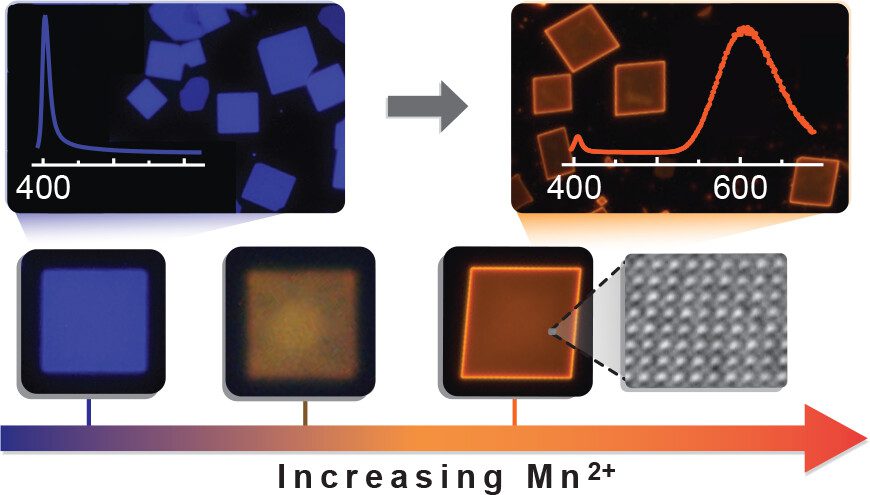
Building on recent crystal-growing successes in the lab, the Kim Group is looking to leverage MOCVD to overcome some of the technical challenges when creating quantum spin semiconductors – namely, how magnetic atoms tend migrate, form clusters, or be unevenly distributed throughout a material.
“We want better materials, and oftentimes, innovative research requires a whole new machinery,” said Seokhyoung Kim, assistant professor in the Department of Chemistry and leader of the project.
By using gases pumped into a heated chamber containing a substrate, MOCVD grows thin films of semiconductor material, atomic by layer by atomic layer, giving researchers exceptional control over crystal thickness and composition.
Long used to grow other classes of semiconductors, the new machine will be specially adapted for the Kim Group’s work with hybrid perovskite materials.
“I’m most excited that we may solve a long-standing problem of achieving high spin dopant concentrations,” said Kim. “Also, the single crystals we’re making look beautiful and gorgeous.”
 For the next generation of materials scientists learning in the lab, the project is likewise a valuable, hands-on crash course in building scientific instruments from scratch.
“Since the system will be designed and homebuilt before we begin the synthesis, that part is personally very exciting for me,” said Ajay Sah, Kim Group graduate student.
Sah added that the new growth method should make it much easier to control exactly where the magnetic particles sit inside each crystal, a level of precision that’s key to designing better materials in the future.
This story was sourced from the Department of Chemistry.
Opportunities for Partnership
The MSU Innovation Center is seeking companies and organizations interested in quantum semiconductor materials, spintronic device development, and advanced thin-film crystal growth technologies.
Whether you’re exploring sponsored research, licensing opportunities, or co-developing quantum spin semiconductor fabrication systems, magnetically doped hybrid perovskite materials, or spin-photonic computing and sensing platforms, we’re ready to collaborate.
Interested in partnering with MSU faculty on quantum materials research and next-generation spintronic and spin-photonic technology solutions?
Visit innovationcenter.msu.edu or contact us to start the conversation.
###
About the MSU Innovation Center:
The MSU Innovation Center serves as the gateway for industry to access Michigan State University’s research expertise, technologies, and talent. Through strategic corporate engagement, sponsored research partnerships, and technology transfer, the Innovation Center connects companies with faculty innovators to accelerate R&D, commercialize new technologies, and bring market-ready solutions to scale. As part of a top-tier public research university, the Innovation Center helps organizations collaborate with MSU to drive innovation and economic growth.
Learn more: Partner with MSU Innovation Center