

A Michigan State University researcher has been honored with the Soil Science Research Award from the Soil Science Society of America, one of the highest honors for advancing scientific knowledge in the field.
Bruno Basso, a world-renowned expert in sustainable agriculture and precision agriculture systems, received the award Nov. 10 at the SSSA’s CANVAS conference in Salt Lake City, Utah.
Basso is a John A. Hannah Distinguished Professor in the MSU departments of Earth and Environmental Sciences and Plant, Soil and Microbial Sciences, as well as the W.K. Kellogg Biological Station. His work is also supported in part by MSU AgBioResearch.
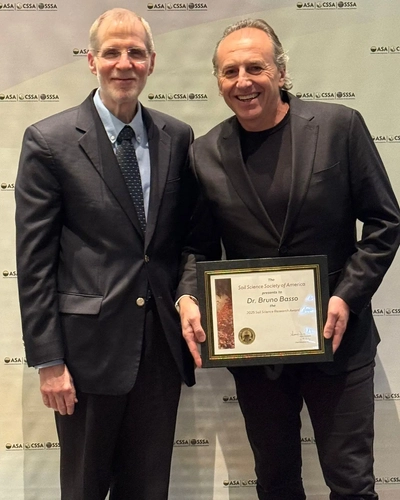
The Soil Science Research Award recognizes outstanding contributions to soil science, including research creativity, reasoning ability, technical skill and significant advances in basic soil science.
“It’s an honor to receive this award from the SSSA, as I’ve dedicated my career to soil science and better understanding how we can improve soil health long term,” Basso said. “Soil is life and we need to continue to improve its health. Healthy soils are an essential component of all environments, especially in agriculture. As growers and ranchers are tasked with producing more food on less land, it’s paramount that we’re good stewards of soil and view it as a precious, finite commodity.”
Basso’s research portfolio is wide-ranging, from using drones and satellites to monitor crop and soil health to leading efforts through the MSU Center for Regenerative Agriculture to promote sustainable farming practices.
Using drones, Basso and his team employ sensors to measure plant nutrients, temperature and size. The information is then integrated into his revolutionary Systems Approach to Land Use Sustainability program that models crop, nutrient, soil and water conditions over multiple years and various management strategies. The program compares management techniques over time under current and future climate scenarios, allowing growers to determine how to apply the right amount of fertilizer at the right place and time, saving money on costly inputs and protecting the environment.
Basso has also developed several novel methods that glean key soil health insights, including an analysis metric known as yield stability zones. While routine soil sampling can prove prohibitively expensive for most farmers, Basso has paired soil samples with historical crop yield information and modeling to successfully identify distinct in-field variability based on relative soil organic carbon and relative soil health. The result can give farmers information on when and where to deliver nutrients and water as needed, while saving on application to higher-quality soil regions.
Recently, Basso published research aiming to more accurately calculate carbon credits, reducing possible errors that undermine trust in carbon markets and misrepresent climate benefits. The study, published in Scientific Reports, evaluated 46 million hectares of cropland throughout the U.S. Midwest.
While many carbon market systems use fixed baselines that fail to quantify soil carbon changes and emissions, Basso’s approach does both — utilizing multiple models that factor in changes due to regenerative agriculture practices such as cover crops, no tillage, crop rotations, adaptive grazing and agroforestry. The project’s goal was to assure farmers that accurate data can be collected, encouraging regenerative practices that are beneficial to the environment and to farmers’ businesses.
“All of my work is geared toward ensuring that we’re using the most efficient practices possible in agriculture to promote sustainability, making farmers sensitive to proper long-term decisions versus short-terms goals.” Basso said. “But there must be recognition that farmers will only adopt new strategies if they make sense economically. We’re showing that we accomplish both goals and that’s exciting for the future of agriculture.”
This article was sourced from MSUToday.
Opportunities for Partnership
The MSU Innovation Center is seeking companies and organizations interested in precision agriculture, soil health monitoring, and sustainable farming technologies.
Whether you’re exploring sponsored research, licensing opportunities, or co-developing remote sensing systems, carbon credit calculation methods, or regenerative agriculture solutions, we’re ready to collaborate.
Interested in partnering with MSU faculty on soil science research and next-generation agricultural sustainability technologies?
Visit innovationcenter.msu.edu or contact us to start the conversation.
###
About the MSU Innovation Center
The MSU Innovation Center is Michigan State University’s hub for corporate partnerships, technology commercialization, and startup support. By integrating MSU Technologies, Business Connect, and Spartan Innovations, the Center transforms groundbreaking research into real-world impact. Each year, the Innovation Center helps launch more than 130 discoveries into patented products and startup ventures, advancing economic development and improving lives locally and globally. Through strategic collaborations with faculty, industry, and investors, the Center accelerates innovation from concept to market—empowering Spartans to lead in entrepreneurship, research translation, and public-private partnerships. Learn more at innovationcenter.msu.edu