


Researchers have reported new experimental results addressing the origin of rare proton-rich isotopes heavier than iron, called p-nuclei.
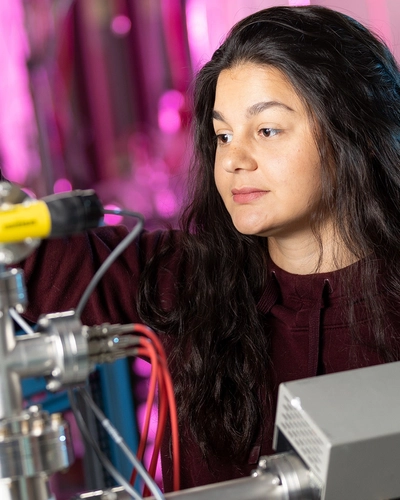
Led by Artemis Tsantiri, then-graduate student at the Facility for Rare Isotope Beams and current postdoctoral fellow at the University of Regina in Canada, the study presents the first rare isotope beam measurement of proton capture on arsenic-73 to produce selenium-74, providing new constraints on how the lightest p-nucleus is formed and destroyed in the cosmos. The team published its results in Physical Review Letters “Constraining the Synthesis of the Lightest 𝑝 Nucleus 74Se”. The work involved more than 45 participants from 20 institutions in the United States, Canada and Europe.
A central question in nuclear astrophysics concerns how and where chemical elements are formed. The slow and rapid neutron-capture processes account for many intermediate-mass and heavy nuclei beyond iron through repeated neutron captures followed by radioactive decays until stable isotopes are reached. However, a group of proton-rich isotopes can’t be produced by these processes. These p-nuclei range from selenium-74, the lightest, to mercury-196, the heaviest.
Several physical processes and astrophysical environments have been proposed as possible sources of p-nuclei. The most favored mechanism is the gamma process, which occurs during certain supernova explosions. In this process, extremely high temperatures generate gamma rays that remove neutrons and other particles from existing heavy nuclei. After the explosion, the resulting nuclei contain more protons than neutrons. By converting a proton into a neutron, a nucleus moves toward a more stable neutron-to-proton ratio and eventually becomes a p-nucleus.
Many of the nuclei involved in the gamma process are rare isotopes, making them difficult to produce and study in the laboratory. As a result, many of their properties are unknown, and models of the gamma process rely largely on theoretical predictions.
“Even though the origin of the p-nuclei has been a topic of study for over 60 years, measurements of important reactions on short-lived isotopes are almost non-existent,” Tsantiri said. “Experiments of this kind are only now possible with facilities like FRIB.”

In this work, the authors were able for the first time to study the proton capture on the radioactive arsenic-73 nucleus in the laboratory to produce selenium-74. During the experiment, a beam of arsenic-73, produced specifically for this experiment, was directed into a small cell filled with hydrogen gas. This gas acted as a proton target located at the center of the Summing Nal detector.
To carry out this measurement, the researchers acquired the radioactive isotope arsenic-73 and operated FRIB’s ReA accelerator in a standalone mode, running it independently rather than receiving beams from the main FRIB linear accelerator. The radiochemistry group, led by Katharina Domnanich, assistant professor of chemistry at FRIB and in MSU’s Department of Chemistry, prepared the material in a suitable chemical form. The sample was placed into FRIB’s batch-mode ion source, where arsenic-73 ions were extracted, accelerated to high energies, and delivered to the experiment — demonstrating ReA’s ability to produce and use arsenic-73 beams in offline mode, which provides increased flexibility.
In the reaction, arsenic-73 captures a proton and forms selenium-74 in an excited state, which releases a gamma ray to gain stability. The research team focused on the inverse reaction, which is the one at work in the gamma process. Its rate can be determined by measuring the direct proton-capture reaction. When reproducing the observed abundance of an isotope, researchers must account for processes that both create and destroy it. For selenium-74, the main remaining nuclear-physics uncertainty in the estimation of abundance in the solar system comes from its destruction by gamma rays during the gamma process.

When the team applied their experimental results into an astrophysical model of the gamma process, the uncertainty in the calculated relative abundance of selenium-74 was reduced by a factor of two. Although this represents a significant improvement, the model still does not fully match the observed abundance of selenium-74. This suggests the need to revise models of the astrophysical conditions of the gamma process.
“These results bring us a step closer to understanding the origins of some of the rarest isotopes in the universe,” said Artemis Spyrou, professor of physics at FRIB and in the Michigan State University Department of Physics and Astronomy, research advisor to Tsantiri, and original architect of the experiment. “Tsantiri’s work is a nice example of the multidisciplinary collaborations needed for advancing the field, and of the kind of professional development opportunities for early career researchers at FRIB.”
This article was sourced from the MSU Today.
Opportunities for Partnership
The MSU Innovation Center is seeking companies and organizations interested in nuclear physics, rare isotope research, and astrophysics applications.
Whether you’re exploring sponsored research, licensing opportunities, or co-developing particle accelerator technologies, radiochemistry methods, or nuclear data analysis innovations, we’re ready to collaborate.
Interested in partnering with MSU faculty on nuclear astrophysics research and next-generation rare isotope technologies?
Visit innovationcenter.msu.edu or contact us to start the conversation.
About the MSU Innovation Center
The MSU Innovation Center is Michigan State University’s hub for corporate partnerships, technology commercialization, and startup support. By integrating MSU Technologies, Business Connect, and Spartan Innovations, the Center transforms groundbreaking research into real-world impact. Each year, the Innovation Center helps launch more than 130 discoveries into patented products and startup ventures, advancing economic development and improving lives locally and globally. Through strategic collaborations with faculty, industry, and investors, the Center accelerates innovation from concept to market—empowering Spartans to lead in entrepreneurship, research translation, and public-private partnerships. Learn more at innovationcenter.msu.edu