


Ralf Schmälzle, associate professor in the Department of Communication, and Hee Jung Cho, a doctoral student in the Department of Communication, have published new research in the Journal of Communication, a leading scholarly journal in the field. The study explores how virtual reality and eye-tracking technology can be used to examine the relationship between visual attention and memory in immersive media environments.
Cho is the lead author of the paper, which was conducted at the Center for Avatar Research and Immersive Social Media Applications in Michigan State University’s College of Communication Arts and Sciences, in collaboration with faculty and student researchers.

The study addresses a long-standing challenge in communication and advertising research: the gap between the opportunity to be exposed to a message and whether that message is actually seen and remembered. In crowded media environments, messages such as billboards, banners and warning signs are frequently overlooked. To better understand how attention translates into memory, the research team developed a “memory inception” paradigm using virtual reality and integrated eye-tracking technology.
“Our findings show that we can use virtual reality and gaze-contingent technology to create a path of influence that was previously difficult to study,” Cho said. “We developed a system where algorithmic manipulations that participants did not notice significantly boosted their memory for specific messages. It shows how malleable attention and memory can be in digital media environments.”
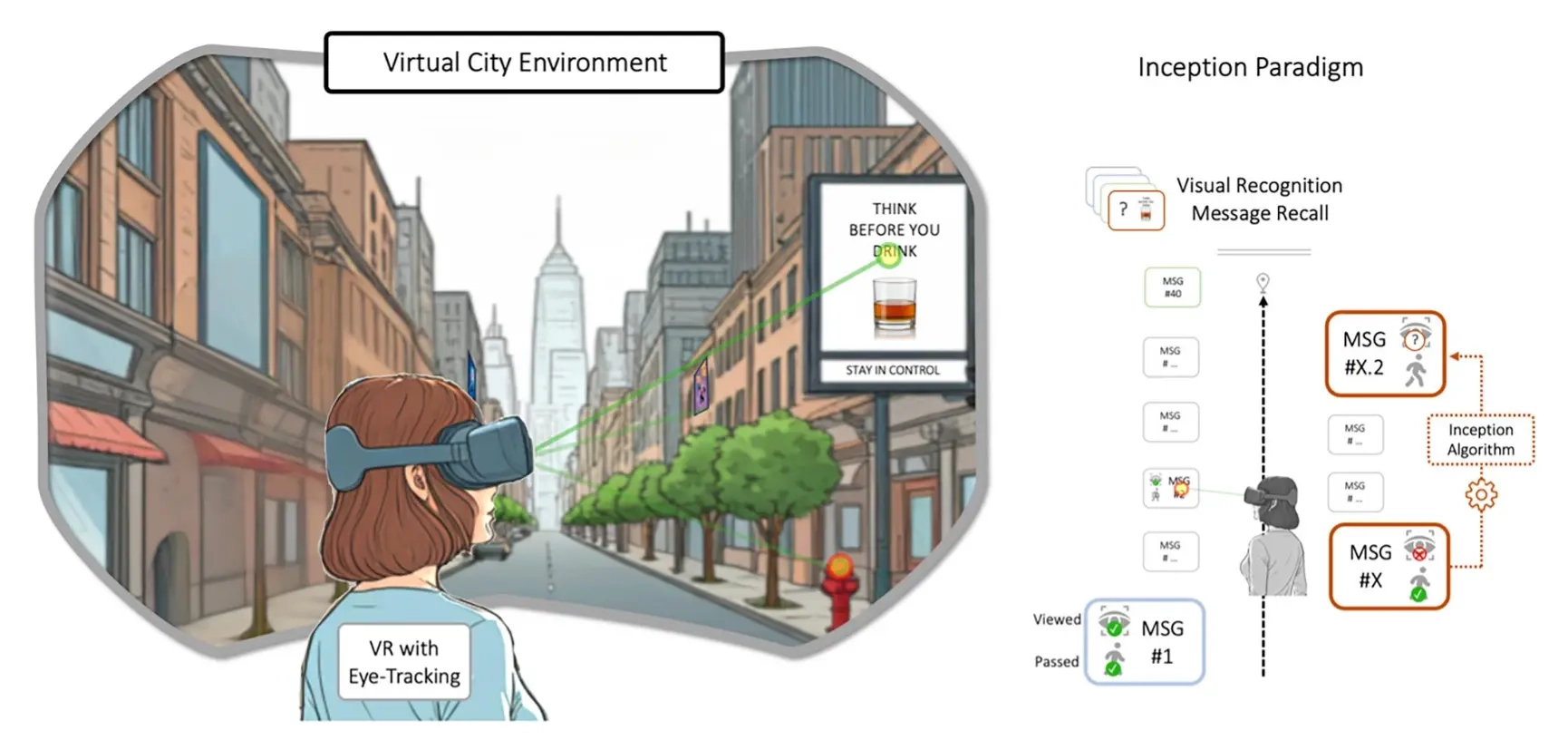
The research placed participants in a realistic virtual city, where they drove past billboards while the system tracked their gaze in real time. If a participant passed a billboard without looking at it, an algorithm replaced a future billboard with the missed message, giving the participant a second opportunity to see the information without noticing the change. The approach allowed researchers to test whether missed messages could be reintroduced based on biometric data and successfully encoded into memory.
“We have taken ideas from movies like Inception or Minority Report to examine a long-standing problem in the social sciences and build a working tool that allows us to see how algorithms can actively alter what we see and remember,” Schmälzle said.
Beyond advertising, the findings have implications for public health, safety messaging and future media regulation. As virtual and augmented reality technologies become more common and eye-tracking is increasingly embedded in consumer devices, the research raises ethical questions related to privacy, surveillance and user agency.
Looking ahead, Cho, Schmälzle and the research team plan to examine whether gaze-contingent environments can influence attitudes and behaviors over time, helping scholars and policymakers better understand how attention may be shaped in emerging media environments.
This article was sourced from the MSU Today.
Opportunities for Partnership
The MSU Innovation Center is seeking companies and organizations interested in virtual reality applications, eye-tracking technology, and immersive media research.
Whether you’re exploring sponsored research, licensing opportunities, or co-developing gaze-contingent systems, attention-based algorithms, or biometric analysis innovations, we’re ready to collaborate.
Interested in partnering with MSU faculty on immersive media research and next-generation attention technologies?
Visit innovationcenter.msu.edu or contact us to start the conversation.
About the MSU Innovation Center
The MSU Innovation Center is Michigan State University’s hub for corporate partnerships, technology commercialization, and startup support. By integrating MSU Technologies, Business Connect, and Spartan Innovations, the Center transforms groundbreaking research into real-world impact. Each year, the Innovation Center helps launch more than 130 discoveries into patented products and startup ventures, advancing economic development and improving lives locally and globally. Through strategic collaborations with faculty, industry, and investors, the Center accelerates innovation from concept to market—empowering Spartans to lead in entrepreneurship, research translation, and public-private partnerships. Learn more at innovationcenter.msu.edu