

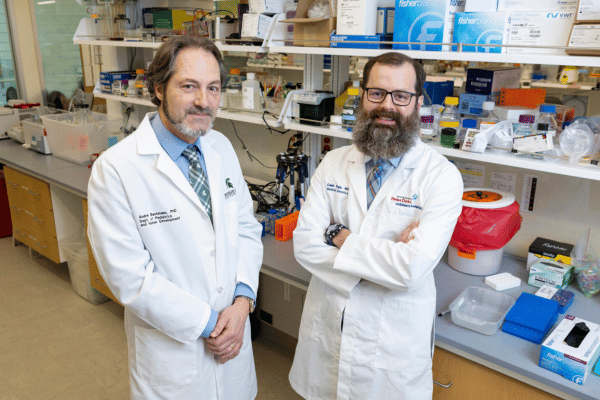
 A first-of-its-kind NIH grant was awarded to Michigan State University College of Human Medicine and Corewell Health. Co-investigators André Bachmann, PhD, MS, professor and associate chair for research in the MSU Department of Pediatrics and Human Development, and Caleb Bupp, MD, FACMG, division chief of Medical Genetics and Genomics at Corewell Health Helen DeVos Children’s Hospital, will advance understanding of how polyaminopathies work. The $7.6M grant will help the research and physician-led team identify new approaches to molecular diagnosis and care, train the next generation of rare disease researchers, and share knowledge with others working to improve the care of those living with rare disease.
Polyaminopathies, a word coined in Grand Rapids, Michigan, comprise a group of rare genetic disorders that cause a variety of neurodevelopmental presentations and other characteristic features. Bachmann-Bupp syndrome (BABS) discovered by the co-PIs receiving this grant, is one of five polyamine pathway-related disorders studied by the Center for Polyamine Disorders (CPD). The CPD is operated through a partnership between Michigan State University and Corewell Health West Michigan including Helen DeVos Children’s Hospital in Grand Rapids and is one of 18 consortia in the Rare Diseases Clinical Research Network (RDCRN).
As the center rapidly emerges as a worldwide hub of information for physicians and families navigating polyaminopathies, it demonstrates the power of the partnership between Michigan State University and Corewell Health.
“I’m a PhD scientist and university professor. I’m not a physician,” said Bachmann. “There is no way I could do this grant without Dr. Bupp and his team at Corewell Health because they’re the ones who see the patients. But at the same time, they could never have done this grant without our academic laboratory-based expertise. It’s truly a mutually beneficial kind of arrangement. Neither of us, in my opinion, would have gotten this grant alone. Our teams work closely together on a daily basis; this is exciting and how it will continue for the next 5 years for the duration of this grant, and possibly beyond.”
The NIH U54 grant titled The Center for Polyamine Disorders (CPD) Consortium of the Rare Diseases Clinical Research Network (RDCRN) will fund more than research, with multiple components including administrative, career enhancement, and pilot study cores, as well as a natural history study and clinical research focused on biospecimen and biomarker analysis and biochemical and molecular assays.
 “The aim of the RDCRN is to develop new treatments,” said Bupp. “That’s their bar. We are very hopeful that the work we have started with difluoromethylornithine (DFMO) and Bachmann-Bupp syndrome (BABS) will get some much-needed support to get that across the finish line to being an approved treatment.”
Work done through the center has already successfully reversed key BABS pathologies by repurposing the drug DFMO, historically used to treat West African sleeping sickness and neuroblastoma, in five patients. For that work, Bachmann was awarded the 2025 Michigan State University Innovator of the Year award.
“This is a landmark achievement for the pediatric research partnership between Michigan State University College of Human Medicine and Corewell Health – Helen DeVos Chlildren’s Hospital and for biomedical research in Grand Rapids,” said Keith English, MD, professor and chair of the Department of Pediatrics and Human Development. This groundbreaking research greatly will improve our understanding of Bachmann-Bupp syndrome and other genetic disorders of the polyamine pathway and will also serve as a model for research on other rare diseases.”
“The collaboration between Corewell Health Helen DeVos Children’s Hospital and our partners at Michigan State University College of Human Medicine demonstrate what is possible when clinicians and researchers come together,” said Robert Fitzgerald, MD, MBA, president, Corewell Health Helen DeVos Children’s Hospital. Drs. Bupp and Bachmann have already made an extraordinary contribution through the discovery of BABS and how DFMO can treat it. This grant will help build on that foundation, accelerating research that brings hope to patients with rare diseases and their families while moving us closer to new treatments and better care.”
Opportunities for Partnership
The Center for Polyamine Disorders shows what is possible when academic science and clinical care work side by side, and it opens doors for partners across the rare disease ecosystem. The team’s work has already reversed key BABS pathologies by repurposing the drug DFMO, and the new grant supports a natural history study and clinical research focused on biospecimen and biomarker analysis and biochemical and molecular assays. Pharmaceutical and biotech companies can explore collaborations on drug repurposing, clinical development and pathways toward approved treatments. Diagnostics and genomic testing companies can partner on biomarker discovery and molecular assays that speed diagnosis for families. Patient advocacy organizations, foundations and health systems can engage in registries, trial recruitment and knowledge-sharing efforts. Organizations interested in sponsored research, licensing or rare disease collaborations are invited to explore partnership opportunities with MSU.
Visit innovationcenter.msu.edu or contact us to start the conversation.
About the MSU Innovation Center
The MSU Innovation Center connects Michigan State University’s biomedical research with industry, clinical and community partners to move promising discoveries toward patients. By advancing rare disease diagnostics and therapies from discovery to marketplace, the center helps turn breakthroughs into real options for families. Through strategic partnerships, technology transfer and licensing, startup support and translational funding, the Innovation Center bridges the gap between the lab and the clinic, building on partnerships like MSU and Corewell Health to strengthen West Michigan’s role as a hub for health innovation.
Learn more: MSU Innovation Center