

For museums and galleries, space is everything. Space helps shape the visitor experience and enhance how visitors view, experience, and interact with exhibits. How to design and shape that space is a focal point for many exhibit curators.
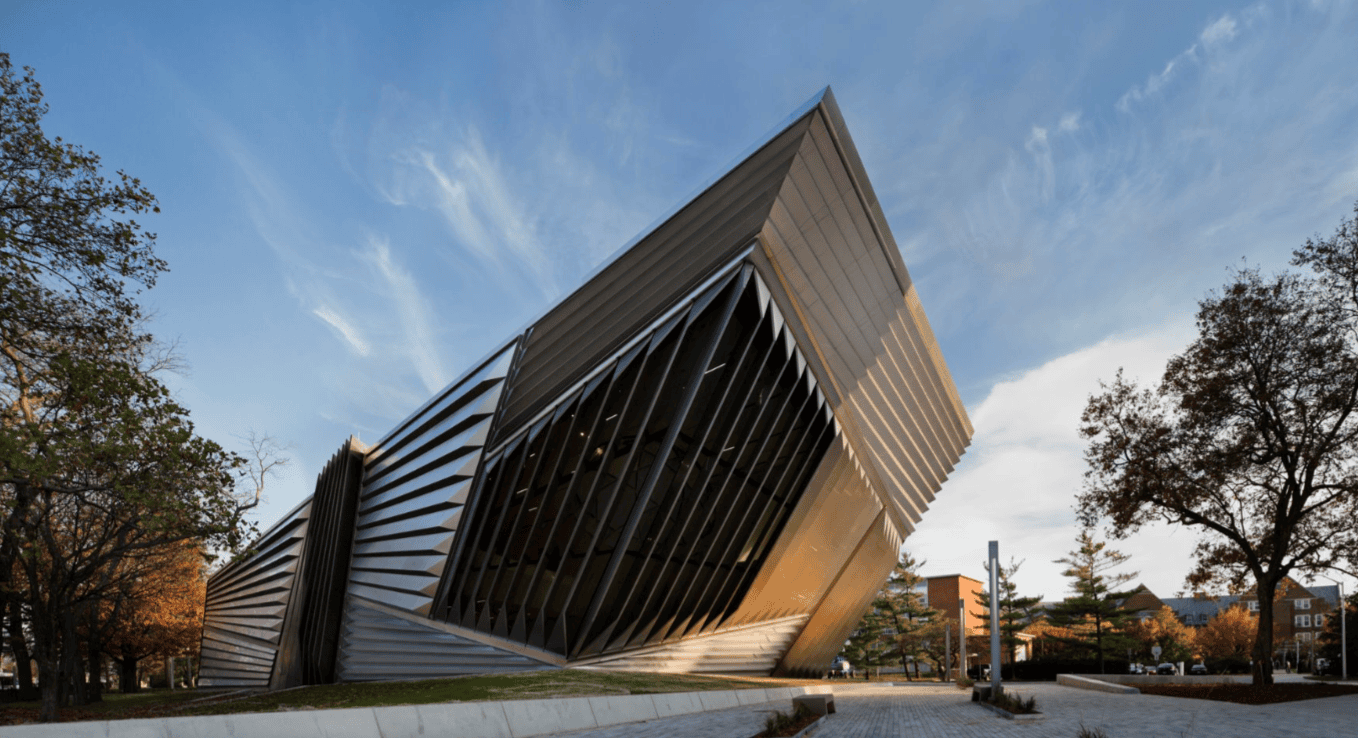
While often overlooked as just part of the building, walls are one of the most important tools available to curators for shaping visitor experiences. They create pathways, partition spaces, block light, support artwork and exhibits, and help curators bring a vision to life. But behind the scenes, creating those spaces often requires a costly and wasteful cycle of building, dismantling, storing, and rebuilding of temporary walls.
After more than three decades designing and constructing exhibition spaces, Brian Kirschensteiner, Chief Preparator of Exhibitions at Michigan State University’s (MSU) Eli and Edythe Broad Art Museum, believed there had to be a better way. That belief has evolved into a patent pending modular wall system that combines the appearance and performance of a traditional gallery wall with the flexibility, sustainability, and long-term cost advantages of a reusable system.
Solving a Familiar Industry Challenge

Kirschensteiner’s inspiration came from a challenge shared by museums everywhere. Temporary walls are routinely built for exhibitions, then taken down when the exhibition ends. While some materials can be reused, many eventually become waste, requiring additional labor, transportation, storage, and disposal.
“I remember thinking, there’s got to be a better way,” Kirschensteiner said, recalling his early years building and dismantling exhibition walls as a student employee.
Over time, he became increasingly focused on the environmental impact of the process. Beyond the materials themselves, he saw hidden costs in the energy required to manufacture components, transport materials, finish walls, and haul debris away after an exhibition ended.
“For me, sustainability is the most important thing,” he said. “It’s heartbreaking to see material go to the landfill that can be reused.”
Reimagining the Exhibition Wall
Existing modular wall systems are available on the market, but many require compromises. Some resemble office partitions rather than architectural walls. Others lack the flexibility or aesthetic quality required by museums and galleries.
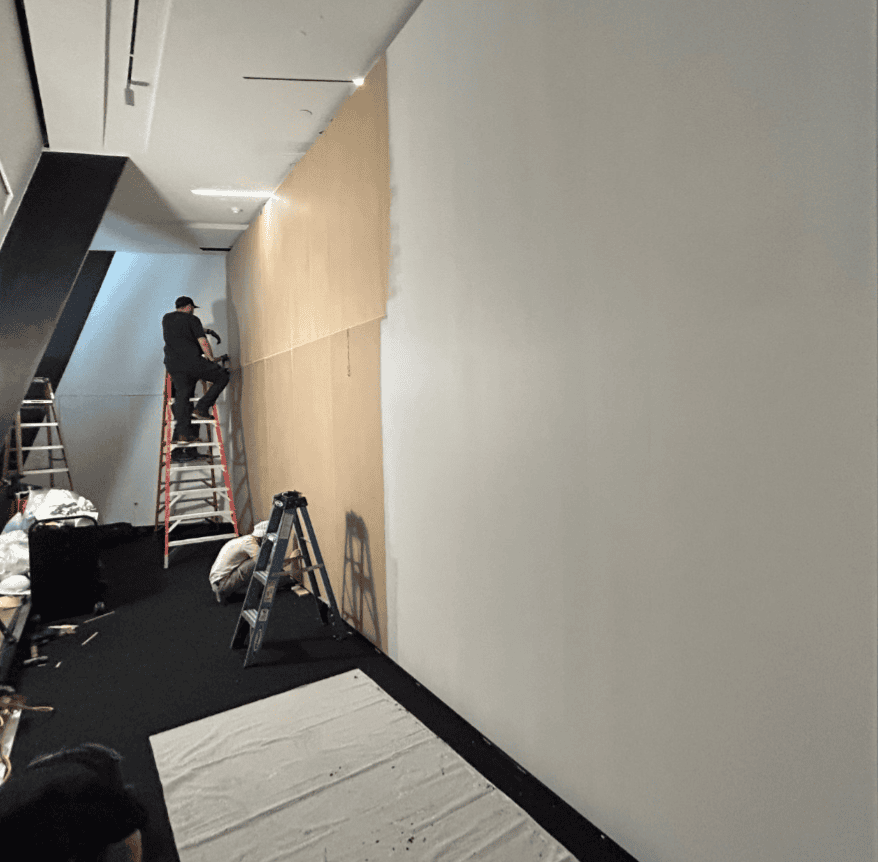
Kirschensteiner set out to design a different solution that could be assembled, disassembled, reconfigured, and stored, while remaining visually indistinguishable from a conventional wall.
The result is a modular wall system that can be configured in many of the same ways as traditional steel-stud construction. Walls can extend floor-to-ceiling, serve as freestanding structures, create light-blocking partitions, divide galleries into distinct spaces, or support unique exhibition layouts. Yet when no longer needed, the system can be disassembled and stored flat for future use.
“My favorite thing is when I bring people in who want to see the walls,” Kirschensteiner said. “They’re looking around asking, ‘Where’s the wall?’ And I tell them, ‘It’s right here.’ They can’t believe it comes apart and can be stored.”
Comparable Cost. Greater Long-Term Value.
The modular wall system was designed to address one of the industry’s most persistent challenges: balancing cost, quality, and time. According to Kirschensteiner, the system delivers benefits across all three categories.
By the Broad Art Museum’s calculations, the cost of constructing a modular wall is roughly equivalent to that of a contractor-built wall of similar size. Unlike conventional temporary walls, however, the modular system can be reused repeatedly. Panels can be used multiple times before replacement is needed, while the steel framework and other structural components could remain in service for decades.
The design also reduces labor requirements by simplifying assembly and allowing organizations to utilize existing staff rather than specialized construction crews. Because components store flat, the system helps alleviate another common challenge for museums: limited storage space.
Taken together, the combination of lower lifecycle costs, reduced waste, smaller storage footprints, and increased flexibility creates a compelling value proposition for museums, galleries, exhibit fabricators, and other organizations that routinely reconfigure interior spaces.
From Prototype to Proven Technology
While the concept evolved over many years, the first prototype was built roughly a decade ago with the help of a student participating in an independent study project. The prototype demonstrated the feasibility of the design and caught the attention of a university structural engineer, who encouraged Kirschensteiner to pursue patent protection. 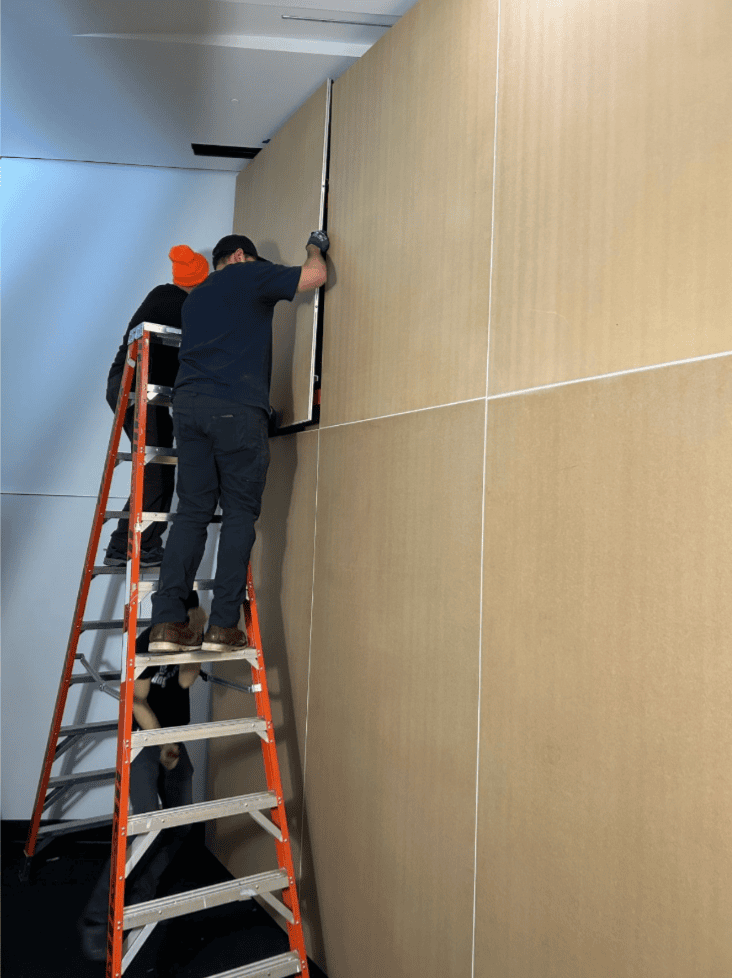
The true test came more recently when the Broad Art Museum needed new gallery walls for a major exhibition. With support from MSU Technologies, part of the MSU Innovation Center’s innovation and commercialization ecosystem, a provisional patent was secured before the walls were put into service. The system was then scaled up and installed in active gallery spaces, providing a real-world proof of concept.
“I was very confident the system was going to work well, and it did,” Kirschensteiner said. “We had a really great proof of concept in a real space.”
How the MSU Innovation Center Helped
Like many innovators, Kirschensteiner developed solutions in response to practical challenges he encountered in his daily work. What he lacked was experience navigating intellectual property protection and commercialization. That changed when he connected with the team at MSU Technologies.
“Innovations with commercial potential can emerge from anywhere within the university. Brian identified a real-world challenge, developed a practical solution, and worked with our team to protect the intellectual property and evaluate market opportunities.” Said Ken Foster, Technology Manager at the MSU Innovation Center, adding, “That’s exactly the type of innovation ecosystem we’re working to support.”
Together Kirschensteiner and MSUT worked to protect the invention, evaluate market opportunities, understand competitive positioning, and explore pathways to bring the technology to market.
“The support from MSU Technologies has been instrumental,” Kirschensteiner said. “I didn’t know what the rules were for protecting something. I didn’t know how to test the waters to see if there’s interest and then bring these things to market. The support from the Innovation Center has been tremendous.”
The partnership also helped Kirschensteiner understand his rights as an inventor and navigate the university’s intellectual property process, allowing him to focus on what he does best: solving problems and creating new solutions.

MSU Technologies also helped Kirschensteiner apply for MSU’s Tech-Dev grant funding, a gap funding program managed by MSUT to accelerate the advancement of MSU technologies with strong commercial potential. The program provides targeted support to enhance, optimize, or further develop selected intellectual property, helping promising innovations move closer to market-ready products and strengthening opportunities for licensing, marketing, startup creation, and other business development initiatives.
The Tech-Dev funding was used to support the Modular Wall team’s participation in the International Conference of Museum Preparators in Stockholm, Sweden. Because the conference was focused specifically on museum preparators, it offered a target-rich environment for customer discovery with members of the modular wall system’s prime customer base. The team conducted more than 23 in-person interviews and identified 10 additional participants who committed to follow-up interviews after the conference, with several interviewees expressing strong interest in the technology.
“Our goal isn’t simply to secure patents,” said Foster, “It’s to connect university innovations with partners who can create real-world impact and deliver value in the marketplace.”
Innovation Beyond the Laboratory
At MSU, innovation can emerge from any corner of a university, not only from research laboratories, but also from museums, classrooms, operational environments, and the daily work of faculty and staff.
“Many researchers, faculty members, and staff solve problems every day without realizing they may have developed a marketable innovation,” says Foster. “One of our goals is helping innovators recognize that potential early enough to protect the intellectual property and explore commercialization pathways.”
From the student employees and Broad Art Museum staff who developed and implemented the technology, to the teams at MSU Technologies and the MSU Innovation Center whose work brings these innovations from the university and into the real world to address real challenges, MSU is making a difference. Kirschensteiner believes that this collaborative environment is one of MSU’s greatest strengths.
For innovators across the university, it offers a powerful example of how the MSU Innovation Center can help transform ideas into opportunities.
Interested in commercializing this technology?
Contact the MSU Innovation Center if your organization is interested in evaluating licensing, development, or commercialization opportunities.
To learn more about licensing opportunities and partnership discussions with MSU, contact Ken Foster: foste462@msu.edu or visit us at innovationcenter.msu.edu
###
About the Eli and Edythe Broad Art Museum at Michigan State University (MSU Broad Art Museum):
The MSU Broad Art Museum creates transformative experiences that connect people to art, ideas, and each other. Presenting art, exhibitions, and programs that engage diverse communities around issues of local relevance and global significance, the museum (designed by celebrated architect Zaha Hadid) advances creativity, community, and connection.
Learn more: MSU Broad Art Museum
About the MSU Innovation Center
The MSU Innovation Center connects Michigan State University’s world-class research and innovation ecosystem with industry and community partners to accelerate discovery, commercialization, and real-world impact. As part of a leading public, land-grant research university, the Innovation Center advances ideas from campus to the marketplace through corporate engagement, technology transfer, startup support, and translational funding initiatives—strengthening Michigan’s economy and delivering solutions that benefit society.
Learn more: MSU Innovation Center