

Why can zebrafish regenerate damaged gut nerves while humans largely cannot?
Michigan State University researchers have developed a powerful new research tool that allows them to remove gut neurons in zebrafish and watch them regenerate in real time, helping scientists investigate one of regenerative biology’s biggest questions.
The research focuses on the enteric nervous system, often called the body‘s “second brain.“ This vast network of neurons is embedded throughout the digestive tract and contains roughly as many neurons as the spinal cord. It controls digestion, nutrient absorption and the movement of food through the gut while remaining in constant communication with the brain.
Although humans and other mammals have only a limited ability to replace damaged gut neurons, zebrafish can rebuild those neural networks within days.
“We knew zebrafish could regenerate nervous system tissue,” said Julia Ganz, associate professor in MSU’s College of Natural Science. “But we didn’t know exactly how regeneration happens in the gut nervous system.”
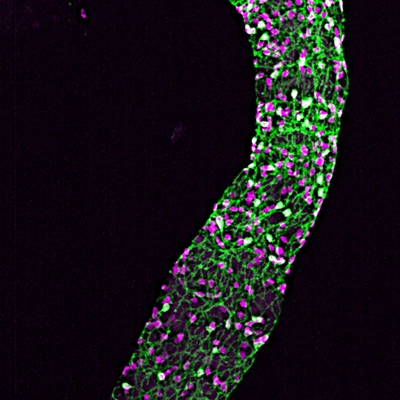
Using the new system, Ganz and her team selectively removed gut neurons in larval zebrafish and watched new neurons regenerate and reconnect with existing neural networks in about nine days.
“The neurons don’t just come back,” Ganz said. “They integrate into the existing nervous system and appear to resume the jobs they were performing before.”
The findings showed that the regenerated neurons not only replaced lost cells but also restored the neural connections needed for normal gut function.
More importantly, the new system gives researchers a controlled way to trigger gut nerve regeneration and investigate the cells, genes and molecular signals that make regeneration possible.
“We’re already looking at what signals play a role in this regenerative response and what cell populations are needed,” Ganz said during an interview. “Once we have a better understanding of how zebrafish accomplish this, the next step is to compare that process with mammals and figure out what’s different.”
The long-term goal is to understand why regeneration occurs so readily in zebrafish but is far more limited in mammals — knowledge that could eventually help researchers develop ways to repair damaged nerves instead of simply treating the symptoms caused by nerve loss.
“Right now, many treatments focus on managing symptoms or surgically removing damaged portions of the digestive tract,” Ganz said. “If we can understand how regeneration works in zebrafish, it may eventually help us develop ways to repair the nervous system itself.”
The findings could eventually have implications for digestive disorders, inflammatory diseases, congenital conditions involving the loss of gut nerves and other diseases that affect the enteric nervous system.
The research was published in Stem Cell Reports.
This story was sourced from MSUToday.
Opportunities for Partnership
The MSU Innovation Center is seeking companies and organizations interested in enteric nervous system regeneration research, digestive disease therapeutics, and comparative regenerative biology platforms.
Whether you’re exploring sponsored research, licensing opportunities, or co-developing gut neuron regeneration model systems, enteric nervous system repair therapeutics, or zebrafish-to-mammal translational research frameworks, we’re ready to collaborate.
Interested in partnering with MSU faculty on enteric nervous system research and next-generation gut nerve regeneration and digestive disease solutions?
Visit innovationcenter.msu.edu or contact us to start the conversation.
###
About the MSU Innovation Center:
The MSU Innovation Center serves as the gateway for industry to access Michigan State University’s research expertise, technologies, and talent. Through strategic corporate engagement, sponsored research partnerships, and technology transfer, the Innovation Center connects companies with faculty innovators to accelerate R&D, commercialize new technologies, and bring market-ready solutions to scale. As part of a top-tier public research university, the Innovation Center helps organizations collaborate with MSU to drive innovation and economic growth.
Learn more: Partner with MSU Innovation Center