


AG3 Labs, a student-founded startup, develops low-cost, highly maneuverable drone systems for military and defense training. Designed to fly in coordinated swarms with repeatable flight patterns, these drones serve as realistic aerial targets, enabling teams to train against agile unmanned threats common in modern conflicts.
Unlike multipurpose drone platforms containing advanced sensors and computing systems, AG3 Labs focuses on a single use case: realistic, scalable training. By removing nonessential technology, their drones are simple, robust, and affordable enough for large-scale deployment, creating training environments that better reflect real-world conditions.
“We’re solving the lack of affordable, maneuverable U.S.-made drones as realistic targets,” says co-founder Ryan Atkinson. “We put drones in the sky for target practice.” 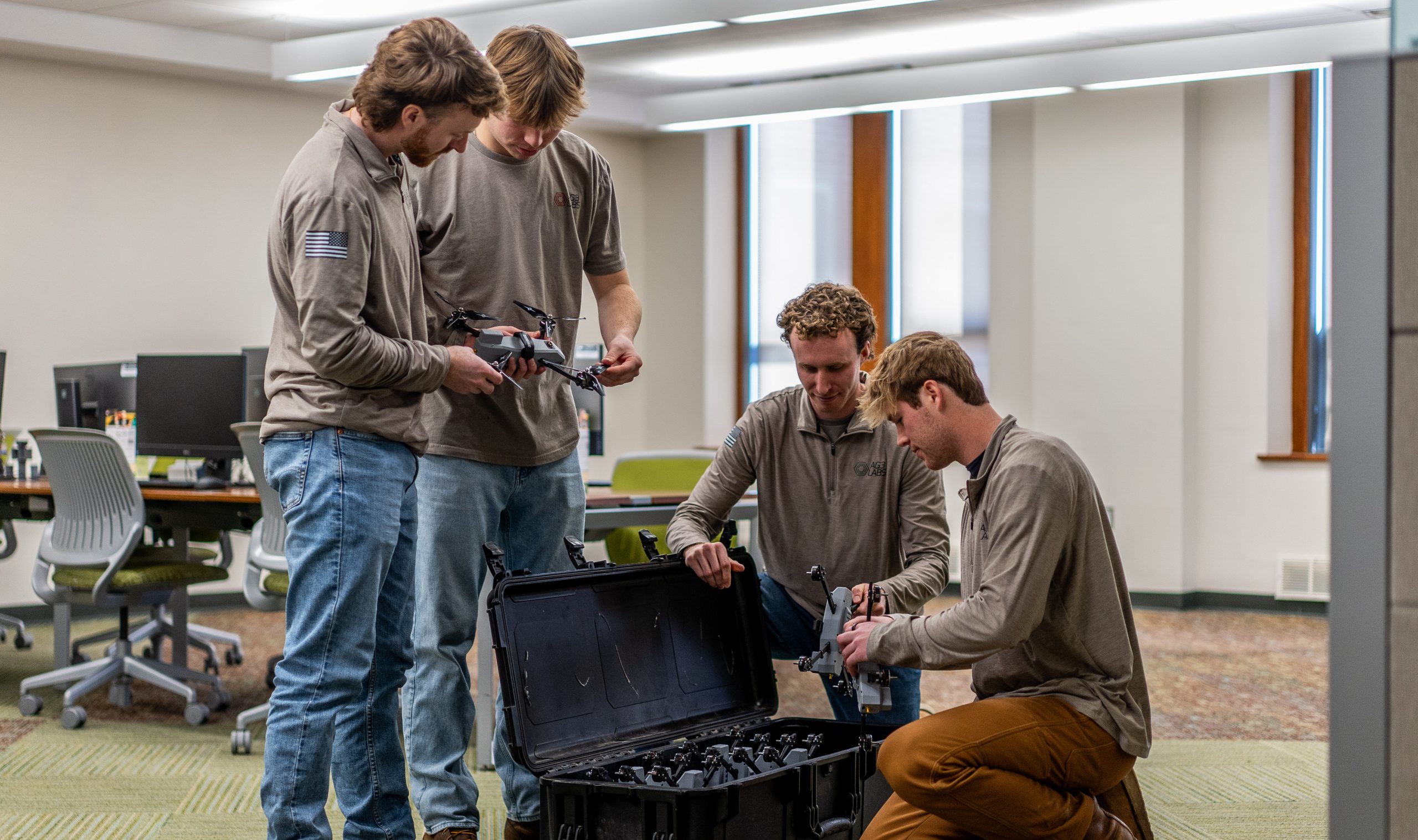
From MSU Research to a Real World Training Problem
The company’s roots trace back to hands on engineering and undergraduate research at Michigan State University, where the four co-founders, Gavin Gardner, Ryan Atkinson, Gryson Gardner, and Matt Atkinson, began working on autonomous drone systems as students.
“Our drone experience started in high school,” says Gavin Gardner. “At MSU, our research on autonomous drones led directly to AG3 Labs.”
The turning point came when the team recognized a gap between emerging drone threats and available training tools. Modern conflicts highlight risks from small unmanned aerial systems, but training environments have lagged behind.
“One of my best friends went through basic training,” Ryan says. “During their ‘drone training’ a drone would be flown overhead, and the trainees were instructed to run into the bushes and hide. That’s when we realized there was a real problem.” 
Engineering for Realism, Not Excess
Addressing this gap, the team designed drones as repeatable, maneuverable targets without the cost and complexity of many existing platforms. Instead of building all-in-one systems, AG3 Labs focused on meeting specific training needs.
“Many companies try to do everything at once,” Gavin explains. “They add every sensor and feature, driving up costs. We took the opposite approach, removing unnecessary elements, and built a product specific to training.”
That design philosophy allowed the team to reduce costs while increasing usability. Their system enables a single operator to quickly deploy large numbers of drones, creating dynamic, unpredictable training environments.
“Our system stands out because a single operator can deploy up to 15 drones with a tablet interface,” Gavin says. “Operators select flight aggressiveness and a designated area, then start automated launch and control routines, creating a chaotic, realistic environment within seconds through synchronized software-controlled missions.”
Validating the Technology in the Field
Although AG3 Labs was formally incorporated in late 2024, momentum grew as the team tested their system with real users. Early demonstrations showed the technology resonated with training professionals seeking realistic, affordable solutions.
“When we started putting ten drones in the sky during demos, the reaction was immediate,” says Matt Atkinson. “People said, ‘We need this.’ That’s when we knew this was more than a cool project. It solved a real problem.”
Validation continued as the team presented their technology at national competitions and field exercises, including Northern Strike, where they received direct end-user feedback.
“Attending Northern Strike and receiving direct warfighter feedback proved invaluable,” Gavin says. “Those one-on-one touch-points confirmed that what we built actually worked and that it mattered.” 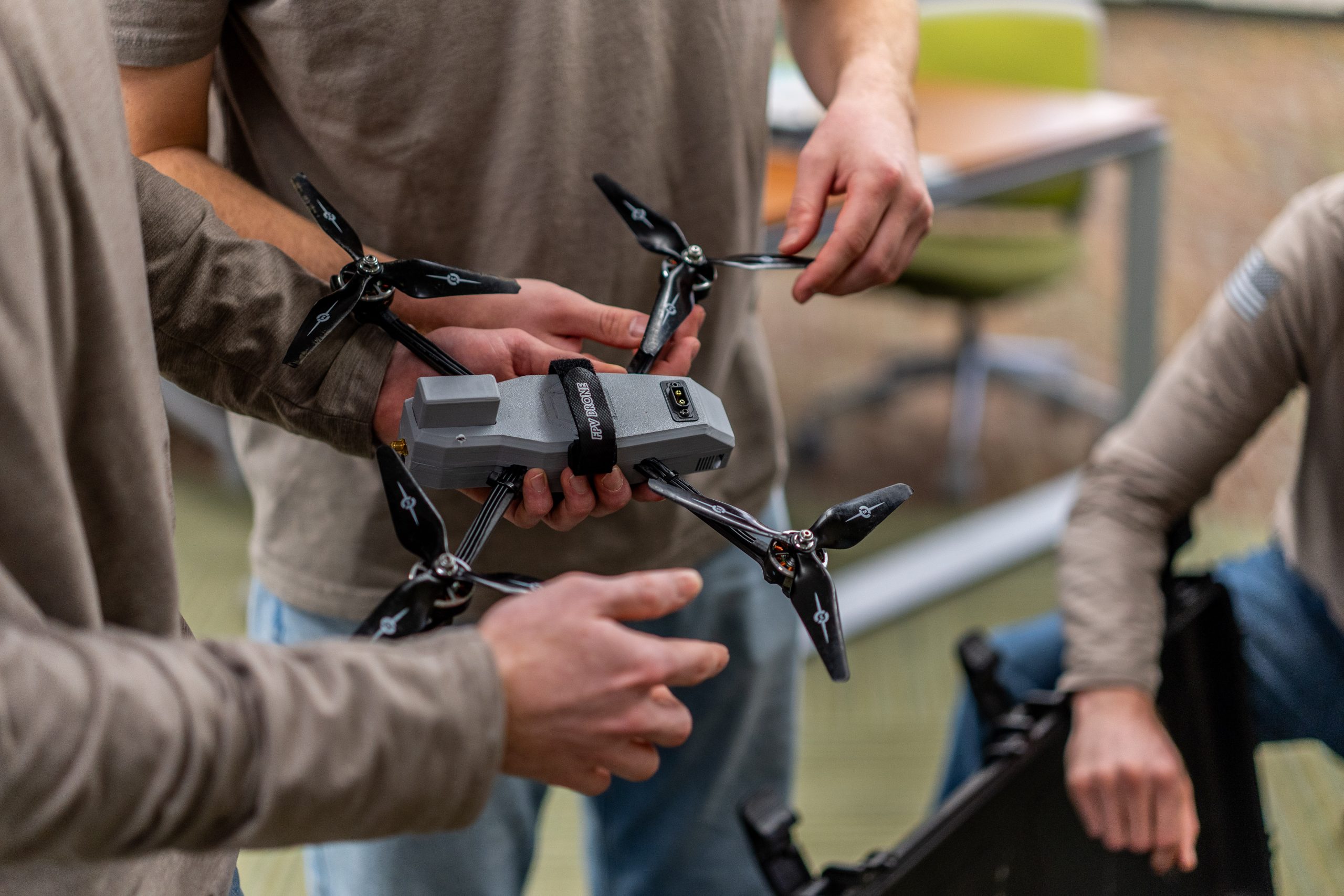
The Role of Burgess: Turning Builders into Founders
While the founders had strong technical skills, building a company required different expertise. Support from the Burgess Institute for Entrepreneurship & Innovation was critical in helping them transition from student engineers to startup founders.
“We had the engineering side figured out,” Ryan says. “Burgess helped us develop the business side, including pitching, obtaining funding, and learning how to run a company.”
“What stood out about AG3 was the team,” says Paul Jaques, Managing Director of Venture Creation at Burgess. “They had a lot of grit. They didn’t have everything figured out initially, but once they did, they pushed forward. That’s exactly what we want to see in student teams.”
Jaques says Burgess helps student teams move from discovery to launch. “We connect them with mentors, fund early travel and competitions, and provide resources to test ideas in real-world settings,” he says. 
Recognition and What Comes Next
For the founders, being named Student Startup of the Year is both an affirmation and a source of motivation.
“It’s rewarding to see our late nights and engineering work recognized,” Gavin says. “More importantly, it helps expose what we’re building to a wider audience.”
Matt echoes that sentiment, noting how recognition continues to open new doors. “All the competitions we’ve been part of keep opening more doors,” he says. “Each one creates new opportunities and pushes us forward.”
Looking ahead, AG3 Labs is focused on scaling from prototype to production by refining manufacturing, establishing supply-chain partnerships, and maintaining affordability as demand grows.
“The question now is how to scale efficiently to build 100, 1,000, or 10,000 units while maintaining cost and performance standards,” Gavin says. “This requires investing in streamlined assembly, vendor selection, and robust quality control as we enter this new stage.”
For Jaques, AG3 Labs exemplifies what’s possible when student innovation is paired with sustained support. “This recognition signals genuine potential,” he says. “Student-led ventures, even in unconventional fields, can drive real progress, and this is just the beginning.”
###
Partner with MSU to Innovate In Autonomous Technologies
The MSU Innovation Center is seeking companies and organizations interested in unmanned aerial systems, defense training technologies, and autonomous drone innovations.
Whether you’re exploring sponsored research, licensing opportunities, or co-developing drone swarm systems, military training platforms, or affordable autonomous aerial target solutions, we’re ready to collaborate.
Visit innovationcenter.msu.edu or contact us to start the conversation.
About the MSU Innovation Center
The MSU Innovation Center supports the commercialization of research, startup creation, and corporate partnerships at Michigan State University. Through technology transfer, venture creation, and industry engagement, the Innovation Center helps transform Spartan research and ideas into market-ready solutions that benefit society and strengthen Michigan’s economy. Learn more at innovationcenter.msu.edu. Learn more at innovationcenter.msu.edu