News Archives - MSU Innovation Center

MSU Scientists Uncover How HPV-Positive Cancers Hide from the Immune System — and How to Make Them Visible Again

College of Human Medicine

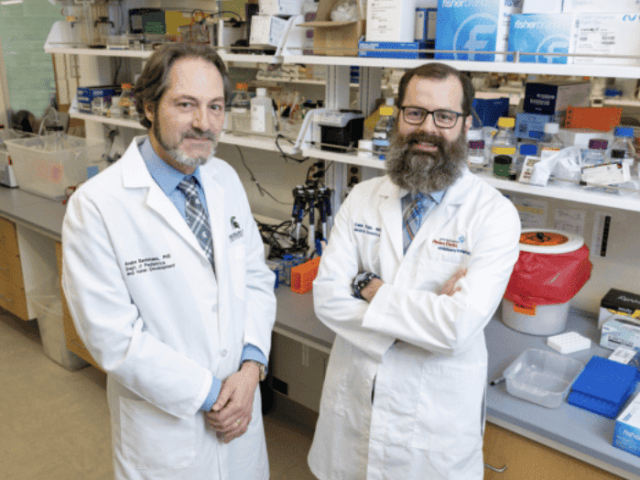
A team of scientists at Henry Ford Health + Michigan State University Health Sciences have uncovered a mechanism that allows certain head and neck cancers to hide from the immune system, a discovery that could change how some of the most treatment resistant tumors are approached. The study, published in Proceedings of the National Academy of …


Transforming waste into a public asset: Michigan State University leads next-generation anaerobic digestion innovation

AgBioResearch

EAST LANSING, Mich. — As conversations continue to build among policymakers and industry leaders on how to best address nutrient runoff, energy transition and sustainable waste management in the Great Lakes region, Michigan State University scientists are pioneering solutions that transform organic waste into a public asset. On May 15, George Smith, director of MSU AgBioResearch, and Wei Liao, …


MSU study demonstrates faster discovery of therapeutic drugs through AI

College of Human Medicine

Inside the diseased cell, the genes are in chaos. Some are receiving signals to overproduce a protein. Others are reducing activity to abnormal levels. Up is down and down is up. The right molecule could restore order, reversing dysregulation in specific genes. But finding the ideal compound could require examining millions of chemicals for their …


Food safety study helps protect pregnant women with Listeria

MSU Today

Listeria is the third-leading cause of death among bacterial foodborne pathogens in the U.S., and pregnant individuals bear a disproportionate share of that risk. Yet the scientific models used to set food safety policy have rarely been designed with pregnant people specifically in mind. A new Michigan State University study to be published in Risk …


MSU, Glanbia collaboration advances environmental sustainability at Michigan dairy processing facility

AgBioResearch

ST. JOHNS, Mich. — Processing billions of pounds of milk each year leaves little margin for error. At MWC, a state-of-the-art cheese and whey protein manufacturing facility in St. Johns, even minor disruptions in wastewater treatment can threaten production, environmental compliance and the livelihoods tied to Michigan’s dairy economy. Through a collaboration with Michigan State University AgBioResearch, the facility …


MSU-Irish researchers collaborate on next-gen wireless communications

MSU Today

A new U.S.-Ireland research partnership, led by electrical engineering professors at Michigan State University, will work to improve wireless communications through location-specific “communications pockets” for more private, secure and efficient wireless communications. The project has the potential to improve next-generation wireless systems, like 5G and 6G. Mauro Ettorre, a professor of electrical and computer engineering, …


Research Spotlight: Slippery surfaces that speed up life-saving diagnostics

College of Engineering

Microfluidic devices can reveal infections, track treatment response, and guide personalized therapies. They power many of today’s vital medical tests, but if the fluid hesitates or sticks to the surface, results can be skewed, take longer, and cost more to produce. Bei Fan, assistant professor in the Department of Mechanical Engineering at Michigan State University, and her …


Research Spotlight: Microrobots combat cancer and clots with pinpoint accuracy

College of Engineering

Clinicians treating cancer and blood clots must balance the risk of medical interventions with their life-saving benefits. Biopsies to collect tissue for testing, ablations to kill diseased cells, and surgery or catheters to remove blood clots are effective but they’re also invasive. New microrobots – smaller than the diameter of a human hair – could …


Mutant Group B Strep strains explain infections in newborns

MSU Today

A new study could explain why some mothers can still pass Group B Streptococcus, or GBS, to their babies after childbirth even when they’re treated with antibiotics. A Michigan State University research team discovered postpartum GBS strains with mutations that allow them to survive in the birth canal and resist treatment. These strains can infect …


Back To Top